
Foundation Work
S.AG Construction is a leading specialist with a vast experience in foundation works across Albania, delivering a comprehensive range of ground engineering solutions for projects of every scale, from infrastructure and industrial developments to high-rise and coastal works.
Ground/Soil Improvement
S.AG Construction provides the most advanced solutions about ground improvement, aiming to enhance the strength and stability of existing soils by increasing their load-bearing capacity, minimizing settlement, and optimizing their overall engineering characteristics.
Vibro Stone Columns / Vibro Replacement
This ground improvement method forms load-bearing columns of compacted gravel or crushed stone using a high-frequency vibrator. The process reinforces weak soils within the treatment zone and densifies the surrounding granular layers, creating a stronger, more stable foundation.
Common Applications
Vibro stone columns are used to enhance bearing capacity, reduce settlement, and increase stability for structures built on soft or loose ground, including buildings, tanks, embankments, quays, and industrial platforms.
Process
In the wet top-feed method, the vibrator penetrates the soil to the required depth through its own weight and vibrations, assisted by water jets at the tip. Crushed stone or recycled aggregate is added at the surface, falling through the annular space created by jetting water to the vibrator tip. As the vibrator is gradually withdrawn in short steps, the stone fills the cavity and is compacted in layers until a dense column is formed up to ground level. In the dry bottom-feed method, no water jets are used; instead, stone is supplied directly to the vibrator tip through a feed pipe. In dense or hard strata, pre-drilling may be necessary to reach the target depth.
Modern vibro rigs are equipped with digital monitoring systems that record parameters such as depth, amperage, and lift rate in real time.
These data allow operators to maintain precise control of the process and ensure that each column meets design specifications.
📍 Durres Marina (Durrës, Albania)
Advantages
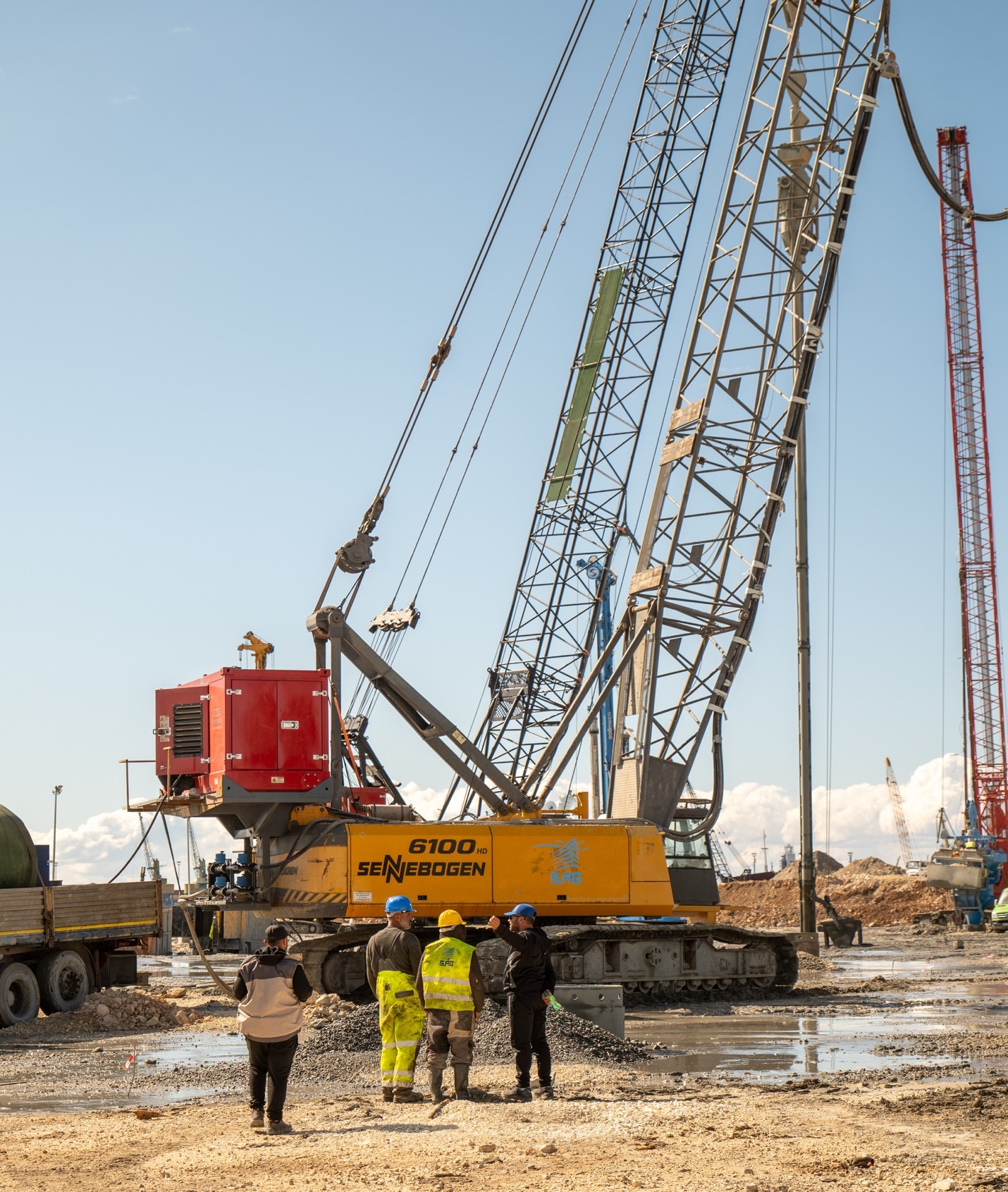
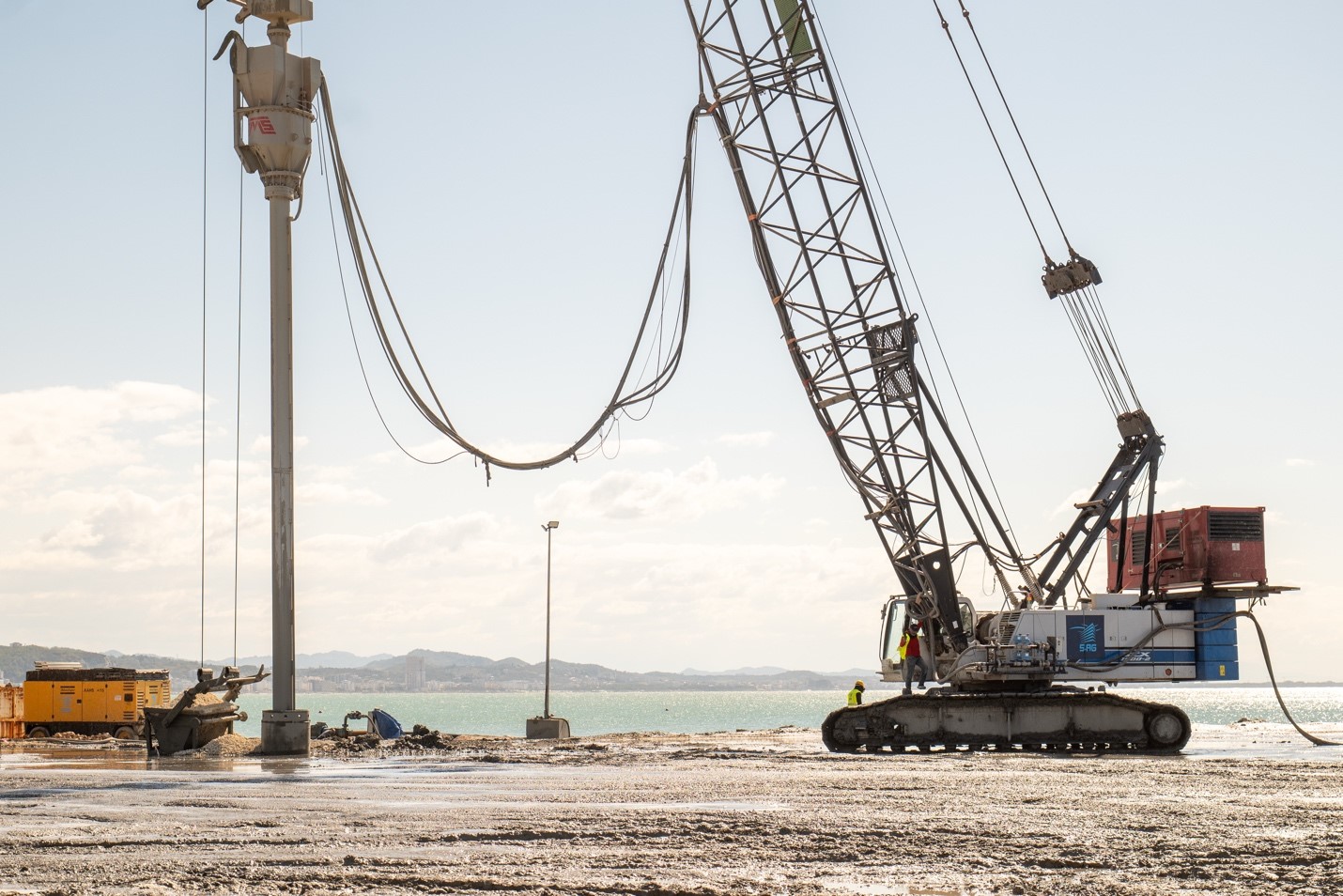
Photos showcasing completed stone column installations in Durres carried out using the vibroflot ground improvement system.
Durres
Dynamic Compaction
Dynamic compaction is a ground improvement technique that strengthens loose granular soils and uncontrolled fills by repeatedly dropping a heavy weight from a height in a controlled grid pattern. The energy from the falling weight densifies the soil, improving its bearing capacity and reducing future settlement.
Common Applications
Dynamic compaction is commonly used to improve loose sands, reclaimed ground, industrial fills, and other weak or disturbed soils where increased density and stiffness are required before construction.
Process
The method involves repeatedly dropping a steel or concrete tamper. Each drop impacts the ground surface, transmitting energy deep into the soil to compact it.
The drops are carried out in a grid pattern, forming a “pass” across the treatment area. Depending on soil conditions, two or three passes may be performed to achieve the desired improvement. After each pass, the depressions (craters) created by the impacts are backfilled with granular material before the next pass begins.
Advantages
Other ground improvement techniques we offer
Deep Foundations
Deep foundations are used when surface soils are too weak to safely support the imposed loads. This method involves constructing structural elements that transfer the building loads to deeper, more competent soil layers or bedrock, ensuring stability and long-term performance.
Bored Piles / Drilled Shafts
Bored piles are modern and highly efficient foundation elements, widely used in geotechnical and civil engineering projects. They provide reliable load-bearing capacity and are suitable for a broad range of ground conditions.
Common Applications
Used for high-rise buildings, bridges, retaining structures, and industrial foundations where large loads and minimal settlement are required.
Process
When ground conditions demand additional support, extra casing or drilling fluids are applied to maintain hole stability. Once drilling reaches the target depth, a full-length reinforcing cage is lowered, and the borehole is filled with concrete.
Advantages
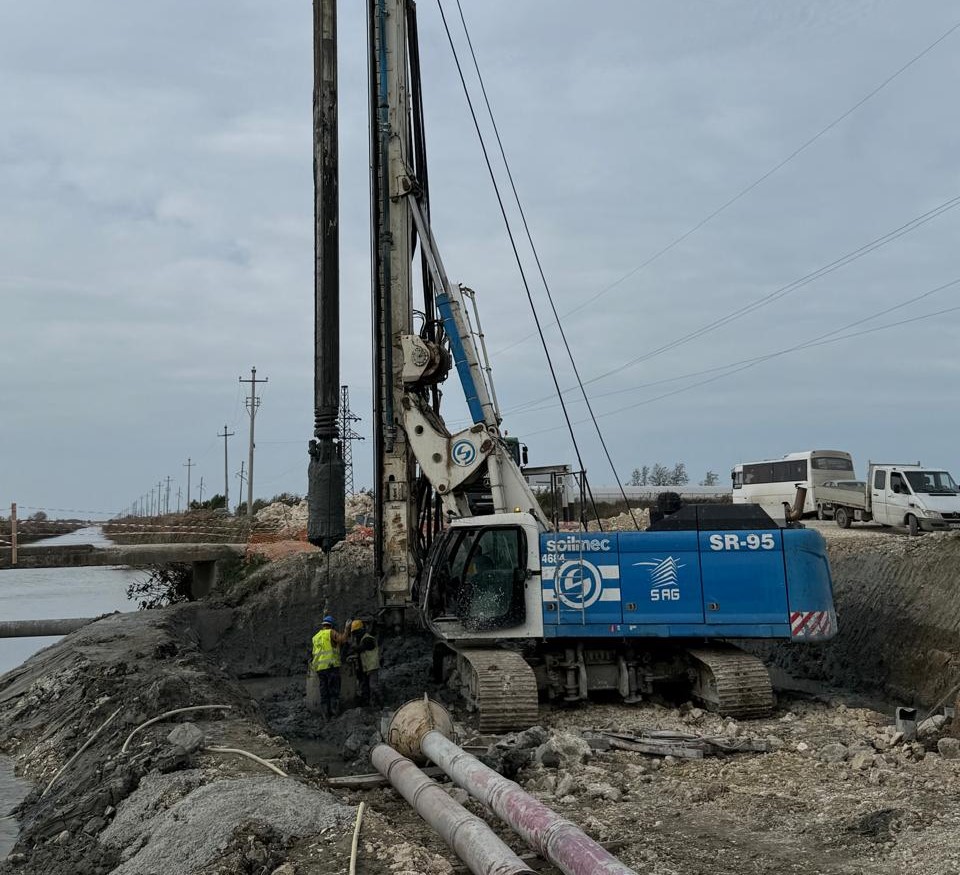
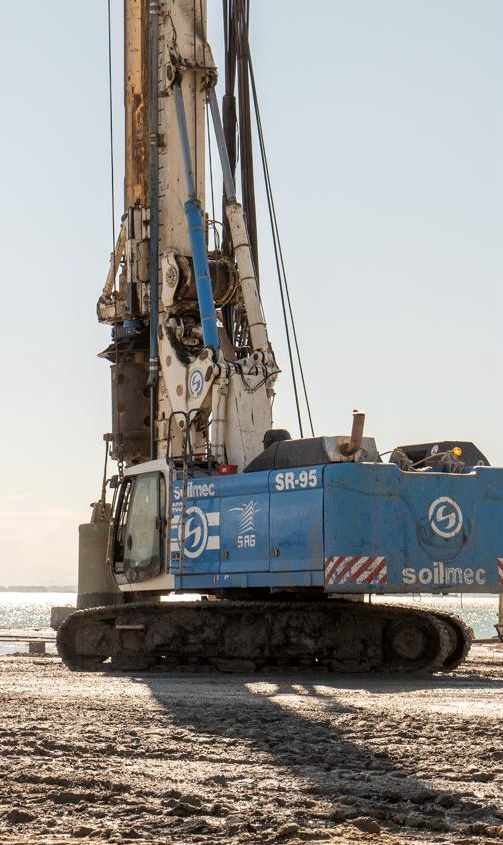
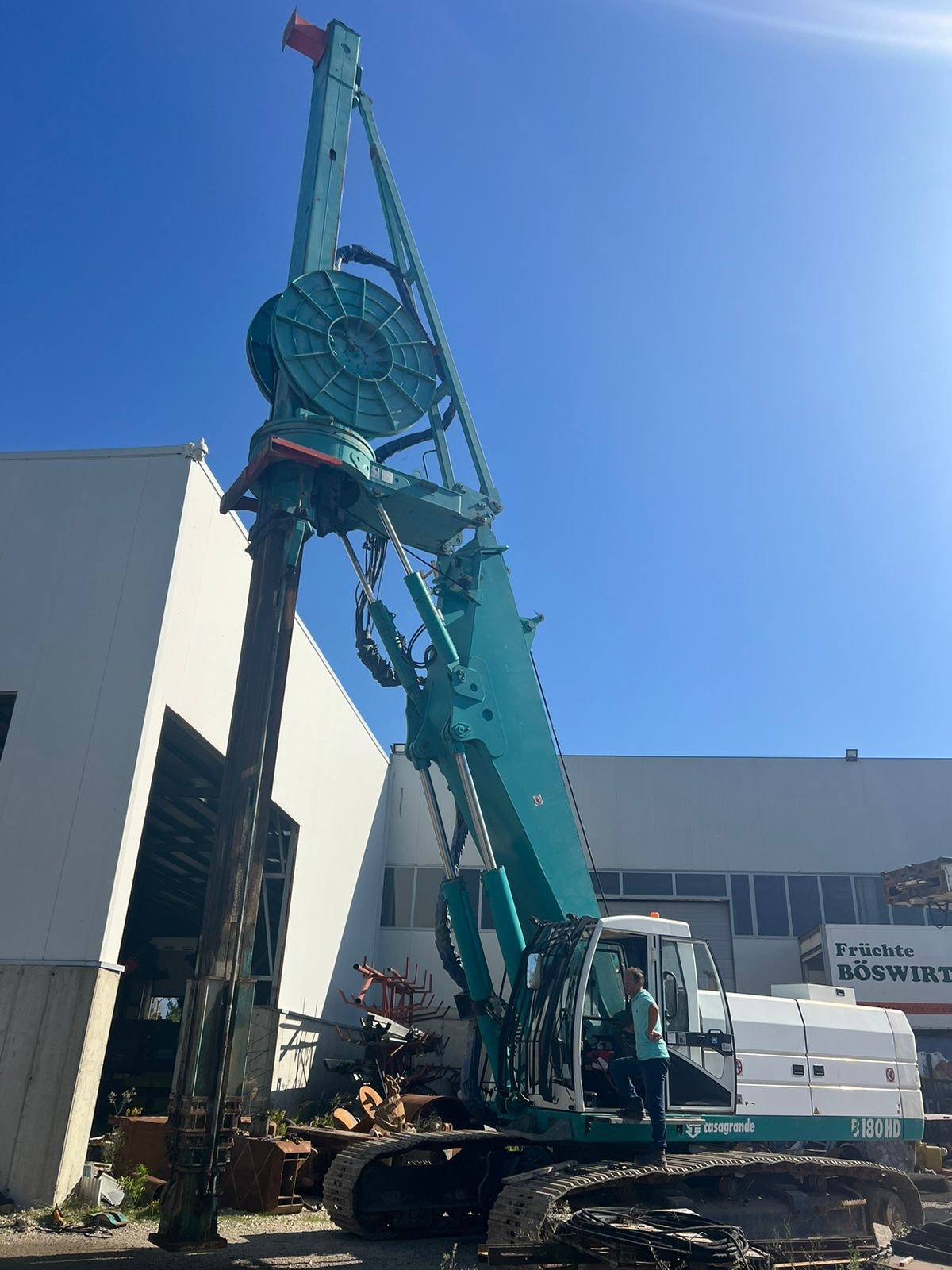
The Soilmec SR-95 rig is one of our key machines used for this process, along with several other models designed for deep foundation and bored piling works.
Photos
CPiles (Auger Cast Piles)
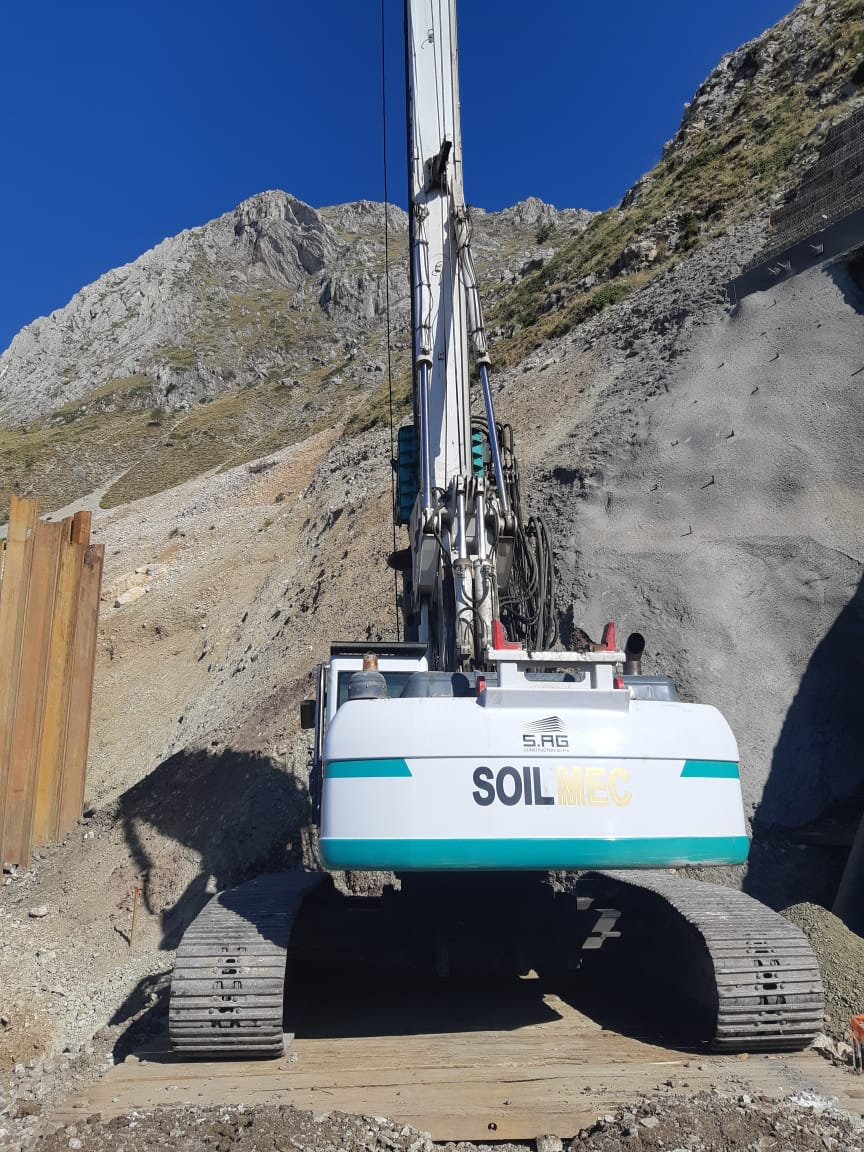
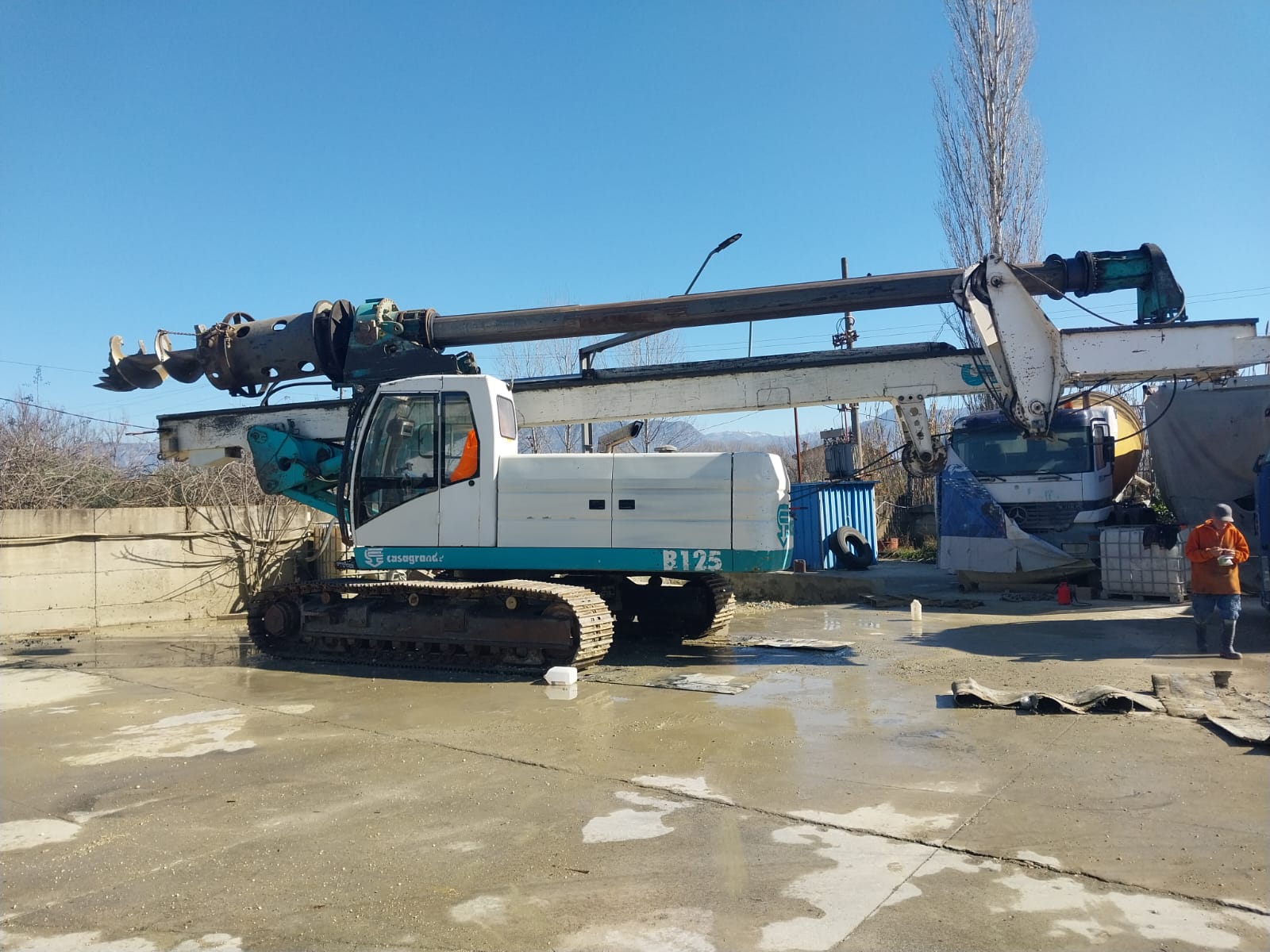
Continuous Flight Auger (CFA) piles are cast-in-place bored piles formed in a single, continuous operation. The drilling and concreting are performed simultaneously, allowing for much faster installation than conventional bored piles. Once the concrete is placed, a steel reinforcement cage is inserted into the fresh concrete, providing resistance against all types of structural loads, such as compressive, tensile, and lateral.
Common Applications
CFA piles are used in a wide range of projects including building foundations, retaining walls, bridge abutments, and industrial structures, particularly where minimal vibration and low noise are required.
Process
The process begins by drilling a hollow-stem continuous auger into the ground to the specified depth. While the auger is gradually withdrawn, concrete or grout is pumped through the hollow stem to fill the void created, maintaining constant pressure to prevent soil collapse.
After concreting, the reinforcement cage is placed into the fresh concrete. For deeper or more precise installations, a vibrating unit may be used to assist in positioning the reinforcement accurately.
Advantages
Photos
Micropiles
Micropiles are small-diameter, high-strength deep foundation elements constructed with steel casing and/or threaded reinforcement bars.
Common Applications
Micropiles are ideal for projects requiring foundation support in restricted or low-clearance areas, for underpinning existing structures, or where ground conditions are complex and access for larger rigs is limited.
Process
A steel casing is drilled to the target depth using a suitable drilling technique. Inside the casing, a high-strength threaded bar or reinforcing element is installed, and cement grout is pressure-pumped to fill the borehole.
Depending on the design, the casing may extend to full depth or terminate above the bond zone, with the reinforcement continuing to the bottom. Load capacities vary according to pile size and ground conditions, in some cases, compressive capacities exceeding 500 tons can be achieved.
Advantages
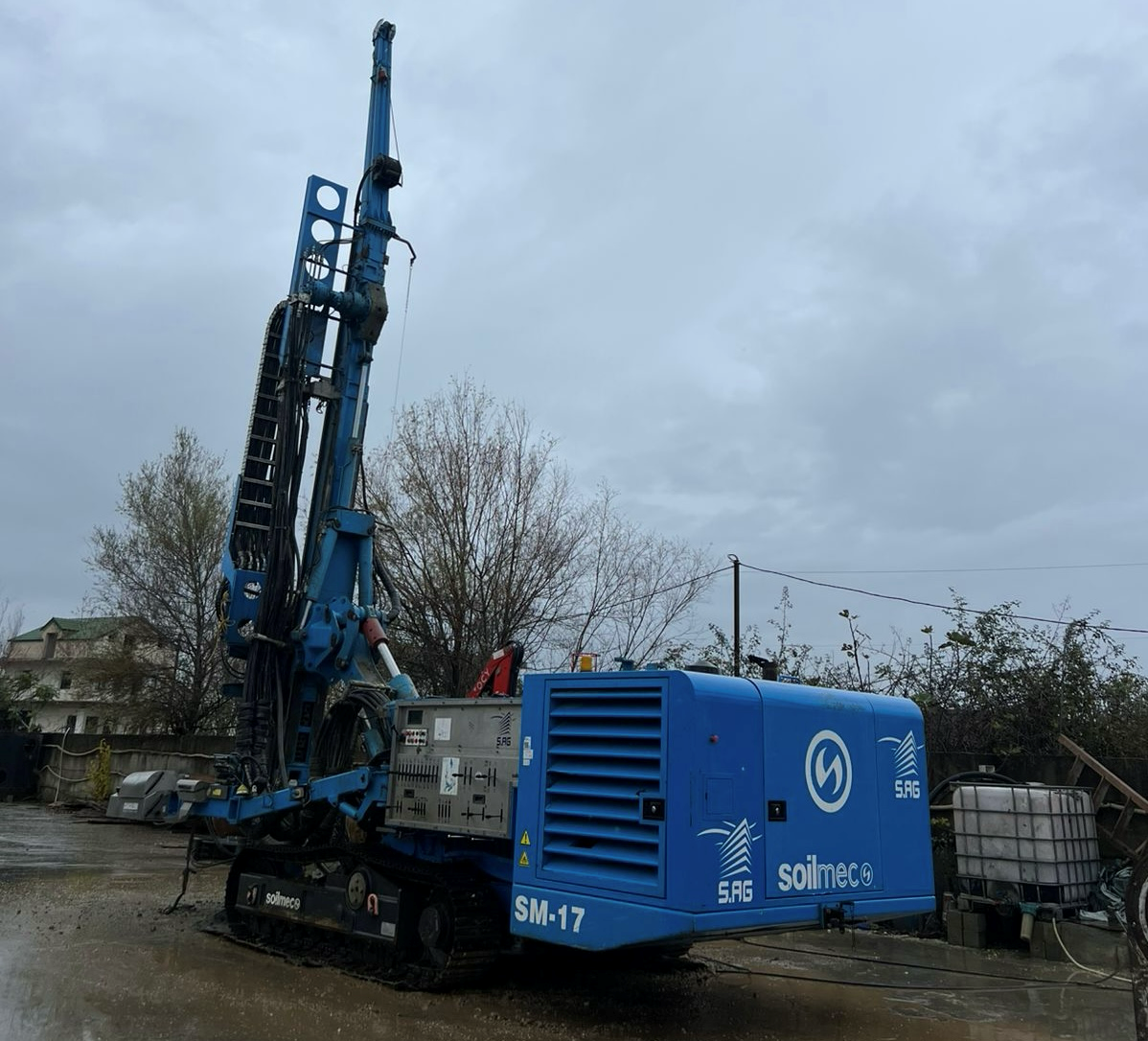
Our fleet includes advanced Soilmec SM-17 drilling rig, ideal for micropile installations, ground anchors etc.
Photos
Macropiles
A macropile is a high-capacity deep foundation element derived from micropile technology. It combines high-strength grout, robust steel reinforcement, and an enlarged diameter to achieve exceptional load-bearing performance.
Common Applications
Macropiles are used to provide structural support for heavy loads, especially in challenging soil conditions or where site access is limited.
Process
A steel casing is drilled or driven into the ground to the required design depth. In cases where the ground remains stable, the borehole can be advanced as an open hole before inserting the casing. Once in place, reinforcement steel is installed inside the casing, and high-strength grout is injected using the tremie method to fill the voids. The casing may extend to the full depth to provide additional structural strength and stiffness, depending on project design requirements.
Advantages
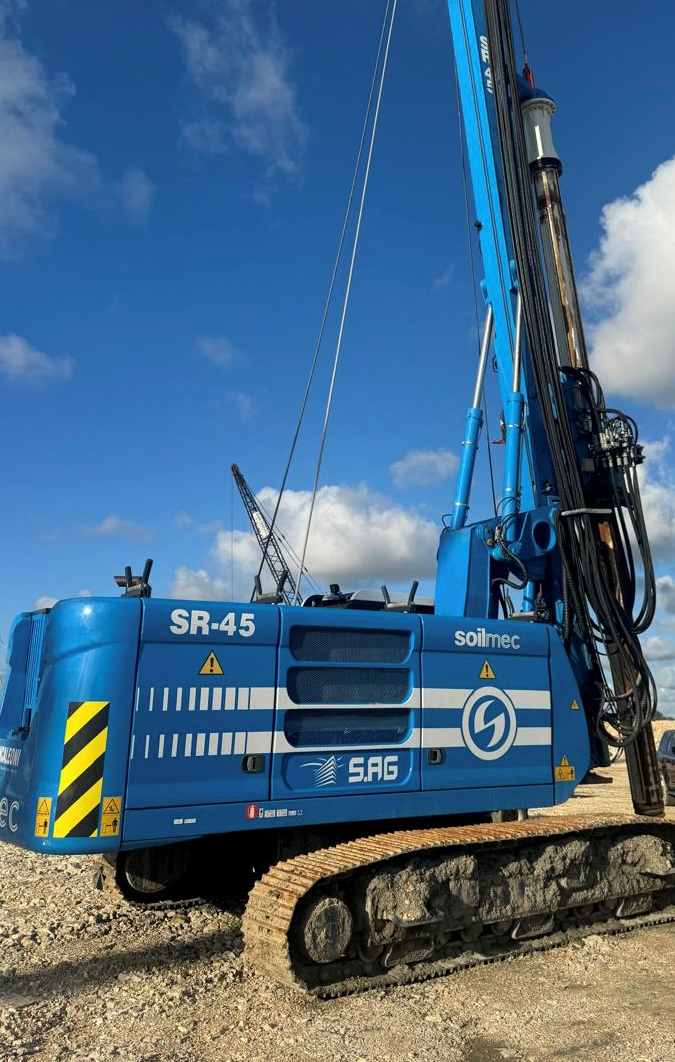
The Soilmec SR-45 is a high-performance drilling rig perfectly suited for the installation of macropiles and is an essential part of S.AG Construction’s specialized foundation equipment fleet.
Photos
Other deep foundations techniques we offer
Earth Retention
Earth retention involves stabilising and supporting soil so that it remains securely in place and does not shift or move in undesired directions.
Anchors
Ground anchors are tension-resisting elements made up of an anchor head, a free length, and a bond length. The free length allows the anchor to stretch and mobilize its full capacity, making it especially useful in excavations where minimal horizontal movement is required.
Common Applications
Used for retaining structures, deep excavations, slope stabilisation, bridge abutments, and any situation requiring controlled lateral support.
Process
A borehole is drilled to the specified diameter and design depth, then filled with cement grout. The anchor is inserted into the borehole.
If needed, post-grouting can be carried out after a few hours to increase bond strength. Once the grout has gained sufficient strength, the anchor head is installed and the anchor is stressed to the required load.
Advantages
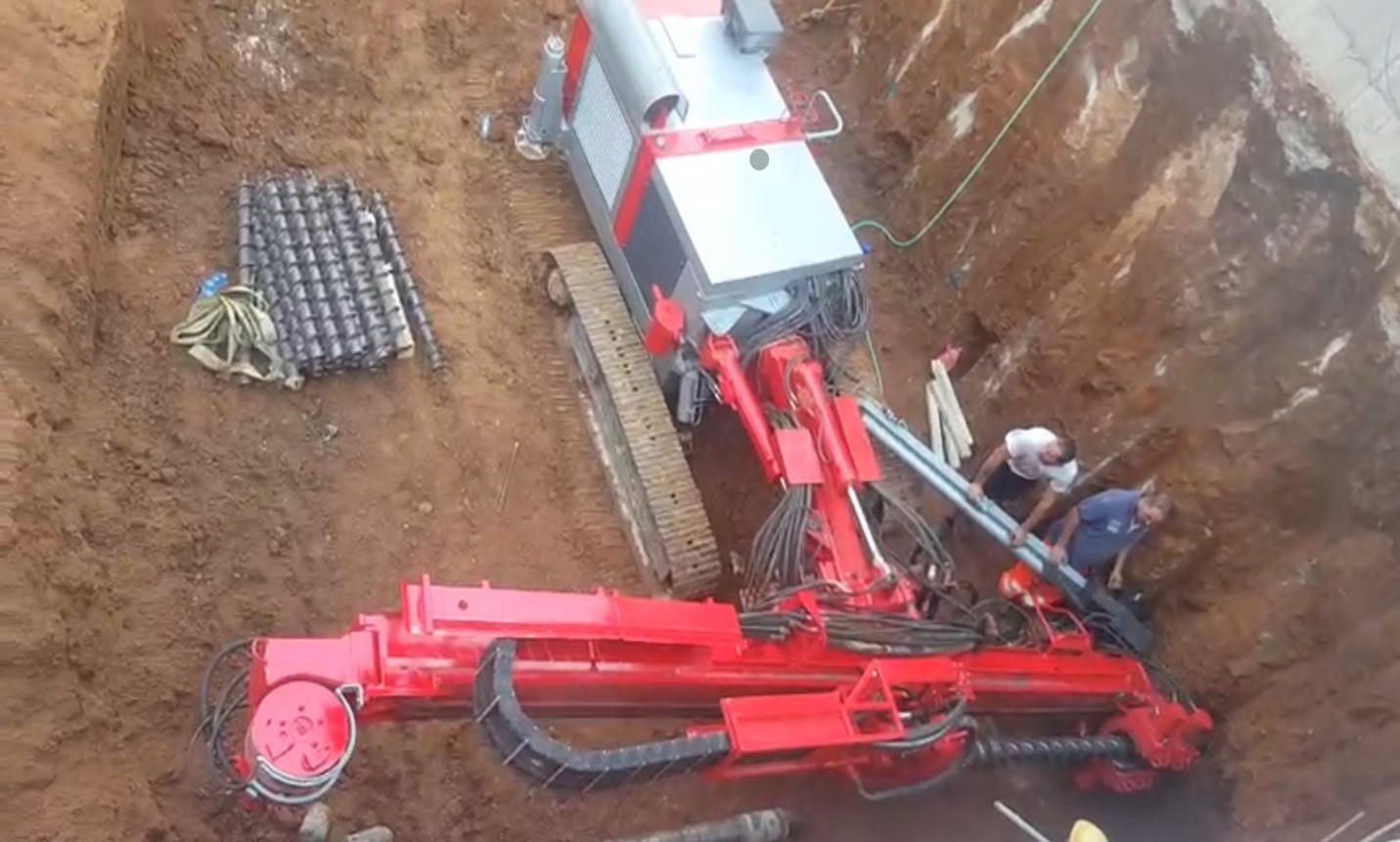
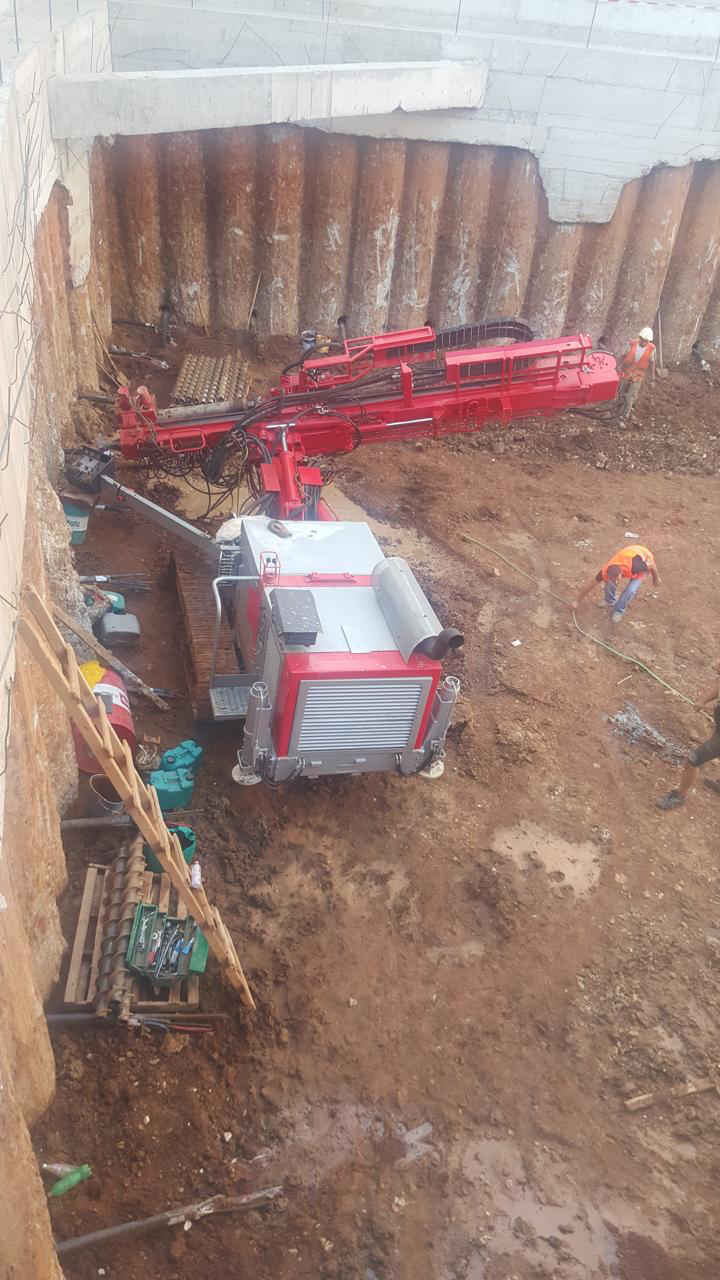
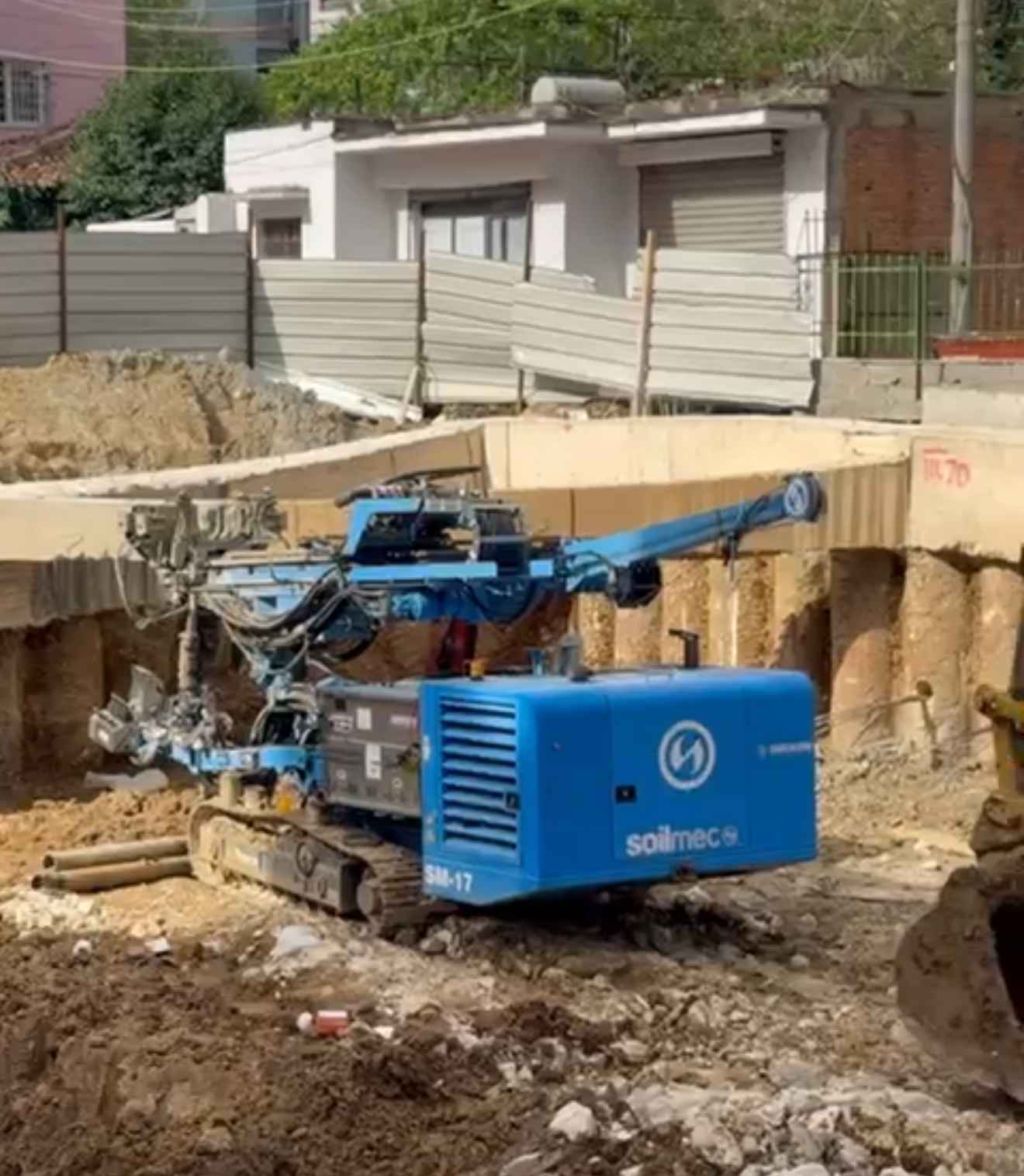
These photos showcase our ground anchor installation works carried out in Laprakë,Tirane.
The anchors were installed to stabilize the excavation and provide reliable lateral support for the retaining structures, ensuring safety and long-term ground stability on site.
Secant Pile Walls
A secant pile wall is built by installing overlapping piles that interlock to create a strong structural wall or a watertight cutoff barrier. Depending on project needs, the design may include steel reinforcement such as bars or beams, and ground anchors can be added to provide extra lateral support
Common Applications
Used for deep excavations, basements, shafts, slope stabilisation, and any situation where groundwater control and minimal soil movement are essential.
Process
Secant pile walls are formed by alternating between reinforced and non-reinforced piles. Reinforcement can consist of steel cages, I-beams, H-beams, or steel channels placed inside the secondary piles.
Advantages
Construction Site-Tiranë
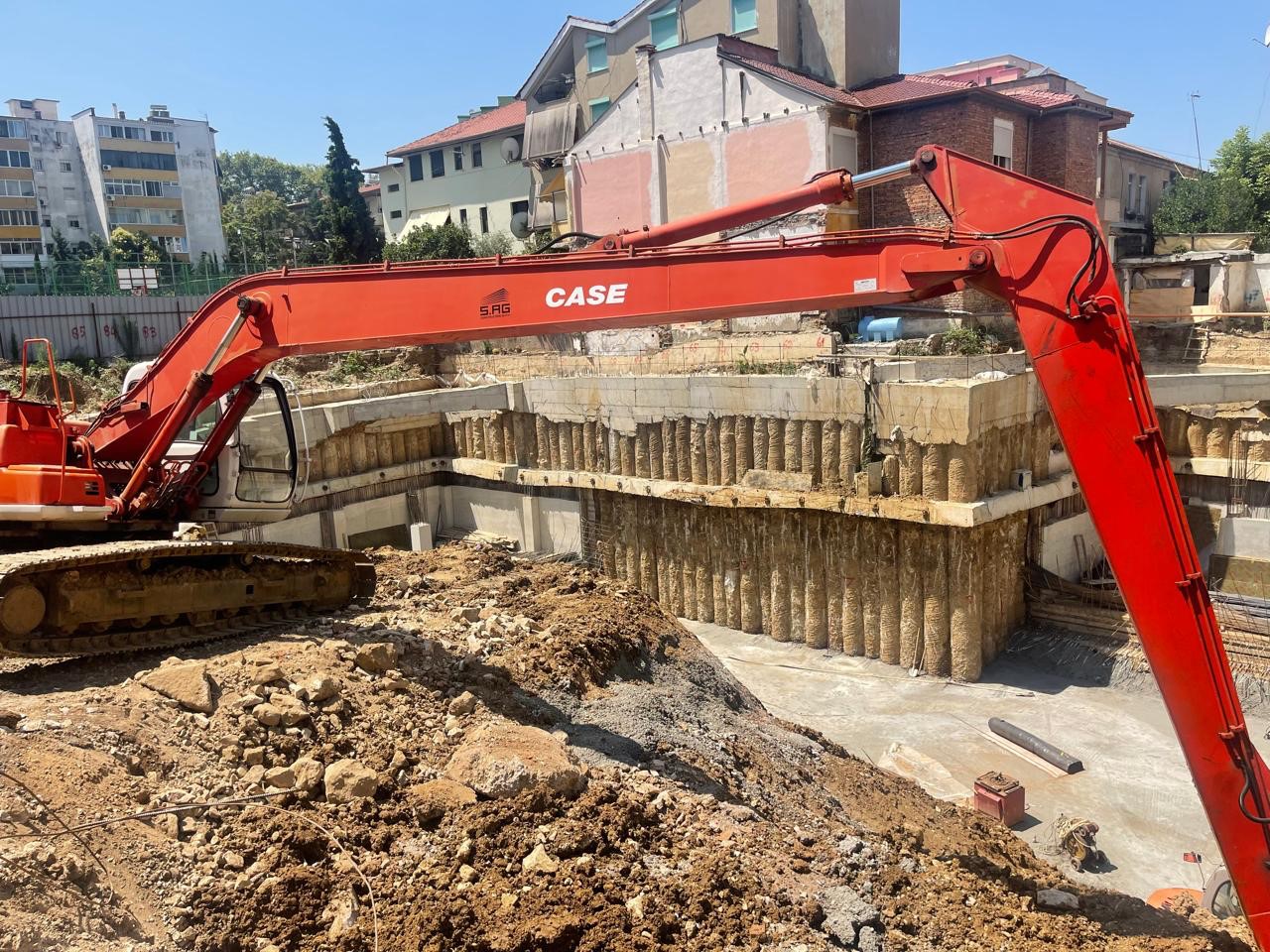
A construction site in Tirana executed by SAG, specialized in the installation of secant pile retaining walls to ensure excavation safety and perimeter stability during the underground construction phases.
Sheet Piles
Sheet piling stabilises soil by driving interlocking steel sheets into the ground. These sheets can be installed using vibratory hammers or vibration-free equipment, depending on site restrictions.
Common Applications
Sheet piles are used to support excavations for underground parking levels, basements, foundations, and pump stations, as well as to construct cofferdams and form seawalls or bulkheads along waterfronts. They also function effectively as barriers to control groundwater movement.
Process
The sheets are driven one after another to the required depth along the excavation boundary or the alignment of a quay wall or seawall. Once locked together, they create a continuous barrier that offers temporary or permanent lateral earth support while limiting groundwater entry. Additional reinforcement, such as ground anchors or internal bracing, can be added where higher loads must be resisted.
Advantages
Sheet piles are an environmentally friendly solution, as they are typically produced from recycled steel and can often be used multiple times. They come in a wide range of sizes and section profiles, making them adaptable to many project requirements. Once installed, they provide an immediate protective barrier that prevents soil movement during excavation. When designed as permanent works, sheet pile walls can deliver long-term durability and reliable performance
Photos
Diaphragm Walls
Diaphragm walls are high-performance structural and retaining systems formed by excavating deep vertical panels under stabilising slurry using cutter machines. They create a continuous wall that ensures ground support, water cut-off, and load-bearing capacity for major underground works.
Common Applications
Perfect for dense urban sites or very deep excavations, diaphragm walls are commonly used for basements, underground stations, tunnel portals, pumping stations, and heavy civil infrastructure. They support both open-cut and top-down construction and can also act as groundwater barriers and structural barrette foundations.
Process
Panels are excavated using grabs or cutters within a slurry-filled trench, then constructed in reinforced (or unreinforced) concrete. Adjacent panels are connected through secant cuts or stop-end formers.
Advantages
Diaphragm Wall Machinery
This is a Diaphragm Wall Grab, part of SAG’s equipment fleet, used for excavating vertical diaphragm wall panels inside bentonite or polymer-supported trenches. The machine provides precise and efficient soil cutting for deep underground structures.
Other earth retention techniques we offer
Marine Works
S.AG delivers full design-and-build solutions for coastal and near-shore marine works, utilising a wide range of marine piling systems and specialist ground engineering methods.
Bridge Construction
A bridge built over water presents unique challenges for foundation works. S.AG applies specialised techniques based on soil conditions, environmental requirements, currents, and water depth to deliver safe and reliable marine foundations.
Common Applications
S.AG supports a wide range of bridge-related works, including the construction of large-diameter foundations, installation of new piles on existing structures, subsea soil improvement for new bridges, replacement or strengthening of bridge spans, and reinforcement of aging bridge foundations.
Process
Bridge foundations can be built using several marine methods depending on access and environmental conditions.
Work may be carried out from a barge with temporary casings to allow clean drilling of large-diameter piles.Where suitable, cofferdams or temporary embankments create a dry work zone for installing barrettes, bored piles, or soilcrete foundations.
For larger structures, seabed improvement with vibro-compaction or vibro stone columns provides a stable base for caissons and other heavy elements.
Advantages
S..AG’s broad capabilities and diverse techniques ensure efficient, tailored solutions for each project. With strong local ground knowledge, we deliver reliable, high-performance foundations for challenging marine and bridge environments.
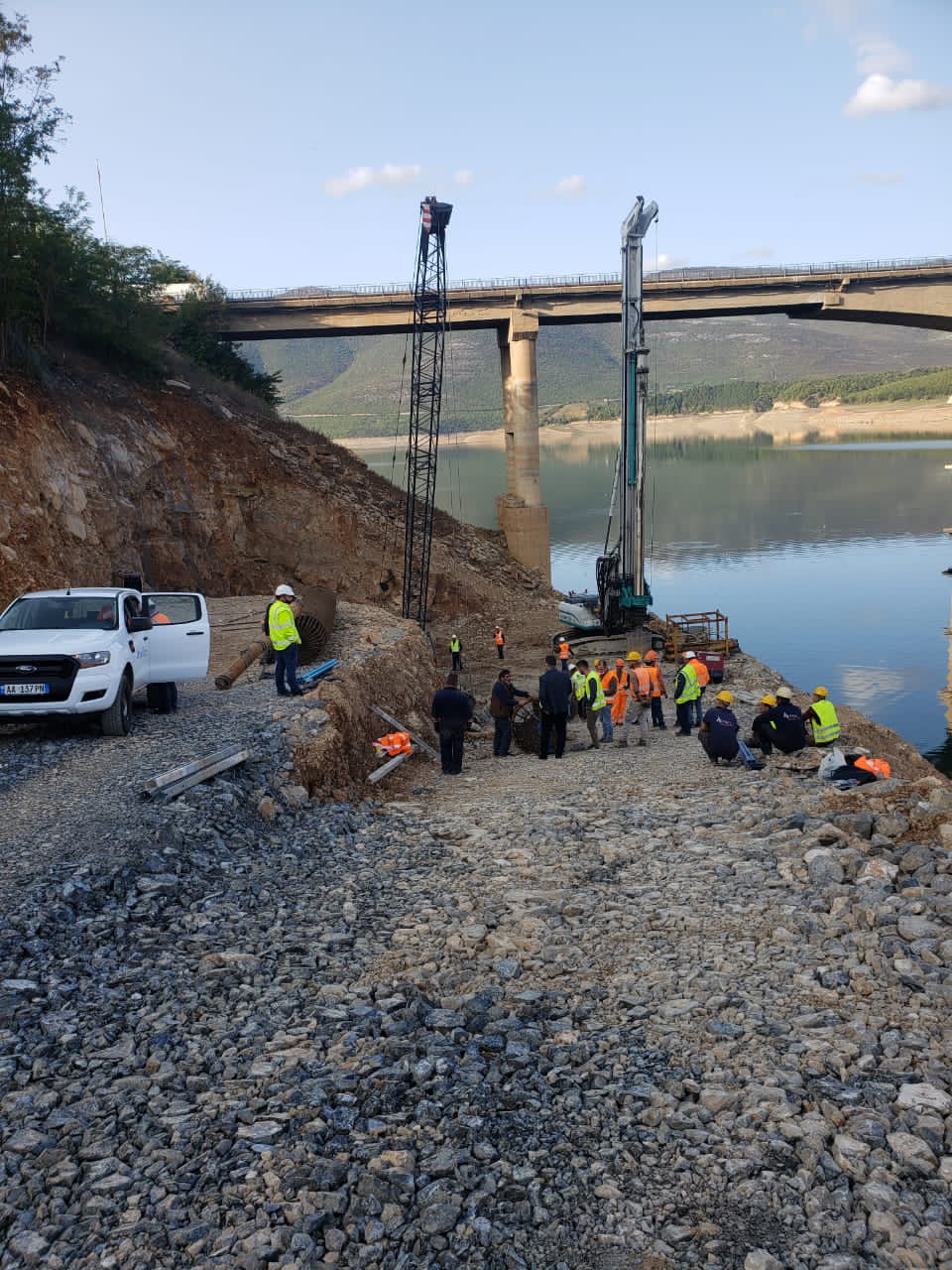
This image shows a bridge construction site where large-diameter pile foundations are being drilled using heavy-duty rotary drilling rigs.
The setup illustrates the type of marine foundation work S.AG carries out in Kukës, ensuring stable and durable support for bridge structures.